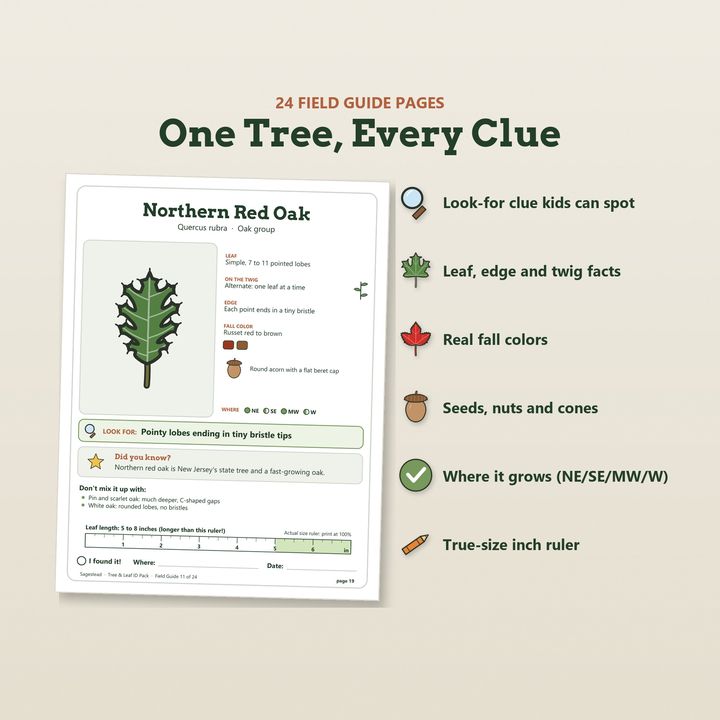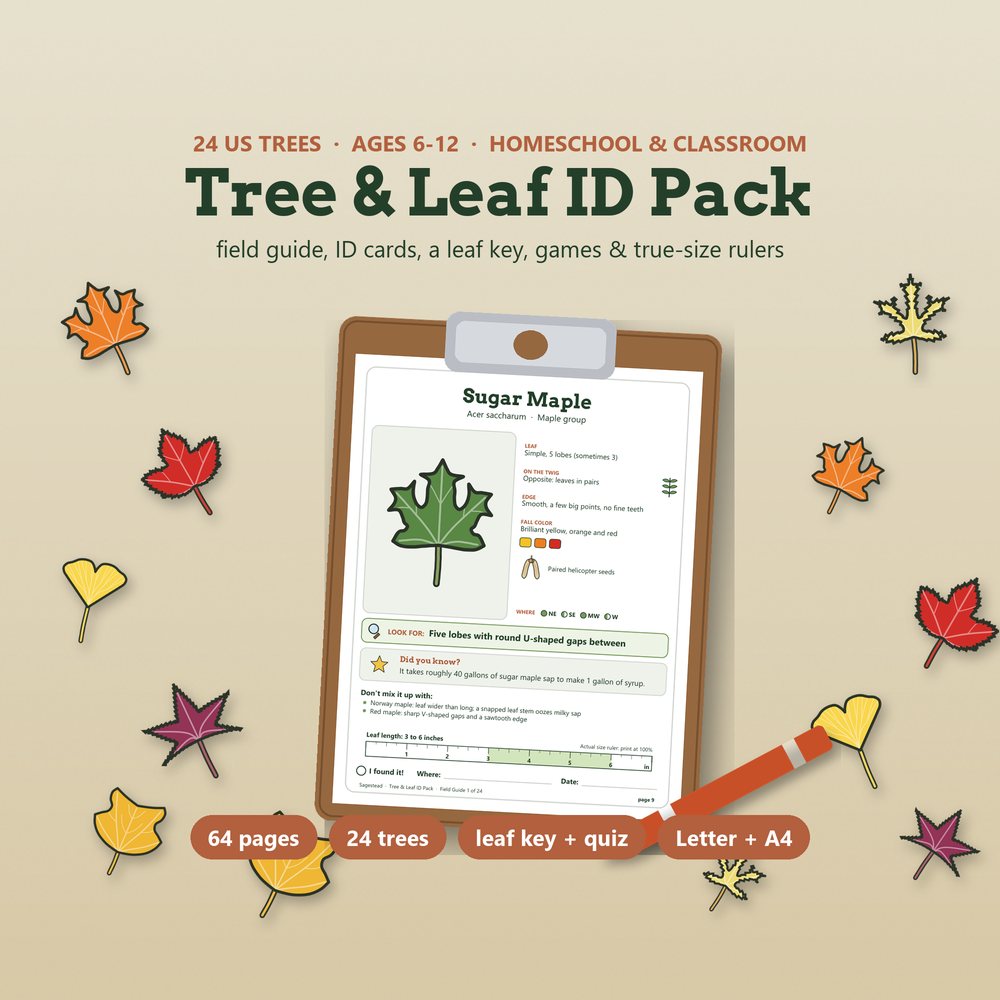
The short answer: to identify a tree by its leaves, check four clues in order. Is it a needle or a flat leaf? Is the leaf simple or made of leaflets? Do the leaves grow in pairs on the twig or one at a time? Is the edge smooth, toothed or lobed? Those four answers narrow most common US trees to a small group, and one last look-for clue usually names it: round U-shaped gaps between the lobes mean sugar maple, and a tiny bristle on every point means a red oak.
Before you start: how to look at a leaf
Leaves on the same tree vary. Shade leaves are often bigger than sun leaves, and a young sprout can look nothing like the grown tree. A few habits make leaf ID much easier.
- Look at several leaves, not just one. Pick the shape you see most often.
- Look at the twig, too. How the leaves attach to the twig is one of the strongest clues, and a single fallen leaf can't show it.
- Take a photo of the whole tree and its bark. Bark, seeds and shape help when the leaf alone isn't enough.
- Write down where and when. Some trees only grow in certain regions, and many are planted far from home in parks and yards.
Safety first, especially with kids: leaves of three, let it be. Poison ivy and poison oak have three leaflets and grow as a vine, a low shrub or ground cover. Poison sumac is a shrub or small tree of wet, swampy places with 7 to 13 smooth leaflets on a red stem. Don't touch any of them, and if someone brushes against one, wash the skin with soap and cool water right away, and wash clothes, shoes and pets that touched it. Look, don't taste: never eat leaves, nuts, seeds or berries you find. Buckeye nuts are poisonous.
The four clues that sort most common trees
- Clue 1Needle or leaf?needles and scales mean a conifer
- Clue 2Simple or compound?one blade, or many leaflets
- Clue 3Pairs or staggered?how leaves sit on the twig
- Clue 4The edgesmooth, toothed or lobed
1. Needle or flat leaf?
Needles and tiny overlapping scales belong to conifers like pines, spruces and arborvitae. They have their own tricks, further down. If the leaf is wide and flat, keep going. One tree stands alone: the ginkgo, whose fan-shaped leaf has fine lines and no middle vein at all.
2. Simple or compound?
A simple leaf has one blade on its stem. A compound leaf is made of several small leaflets on one stalk. The leaflets can run along the stalk like a feather, as on ash and black walnut, or spread from one point like fingers on a hand, as on buckeye.
How do you know where a leaf starts? Find the bud. A bud sits at the base of the whole leaf, never at the base of each leaflet. If there's no bud where a "leaf" meets its stalk, you're holding one leaflet of a compound leaf.
3. In pairs or staggered?
Look at how the leaves attach to the twig. Opposite leaves grow in pairs, across from each other. Alternate leaves grow one at a time, staggered up the twig.
Few trees have opposite leaves, so this clue does a lot of work. Foresters remember them as MAD Horse: Maple, Ash, Dogwood and Horse chestnut, which includes the buckeyes. Most other trees you'll meet, like oaks, sycamore, sweetgum and tuliptree, are alternate. Check the twig itself: the leaflets of a compound leaf can pair up on any tree.
4. The edge, and the veins
Is the edge smooth, toothed like a saw, or cut into big bumps or points called lobes? Then look at the veins. They can branch from a middle vein like a feather, spread from one point like a hand, curve toward the tip like a rainbow, as on flowering dogwood, or fan out with no middle vein, as on ginkgo.
| What you see | Likely group | Common US examples |
|---|---|---|
| Simple, lobed, leaves in pairs | Maples | Sugar, red and silver maple |
| Compound, leaves in pairs | Ash, boxelder, buckeye | Green ash (usually 7 to 9 leaflets), boxelder (usually 3 to 5), Ohio buckeye (5 from one point) |
| Compound, one leaf at a time | Walnut | Black walnut (15 to 23 leaflets) |
| Lobes lined up along a middle vein, one leaf at a time | Oaks | White oak, northern red oak |
| Other lobed shapes, one leaf at a time | Special shapes | Sweetgum (a star), tuliptree (flat top), sassafras (a mitten), sycamore (huge, shallow lobes) |
| Toothed, no lobes | Toothed leaves | American elm (lopsided base), quaking aspen (round, flat leaf stem) |
| Smooth edge, no lobes | Smooth leaves | Redbud (a heart), flowering dogwood (curving veins), southern magnolia and live oak (leathery evergreens) |
A simple leaf key: answer yes or no
Botanists use a key: a chain of yes-or-no questions, each one sending you to the next. Here is a short version for common US trees. Start at 1.
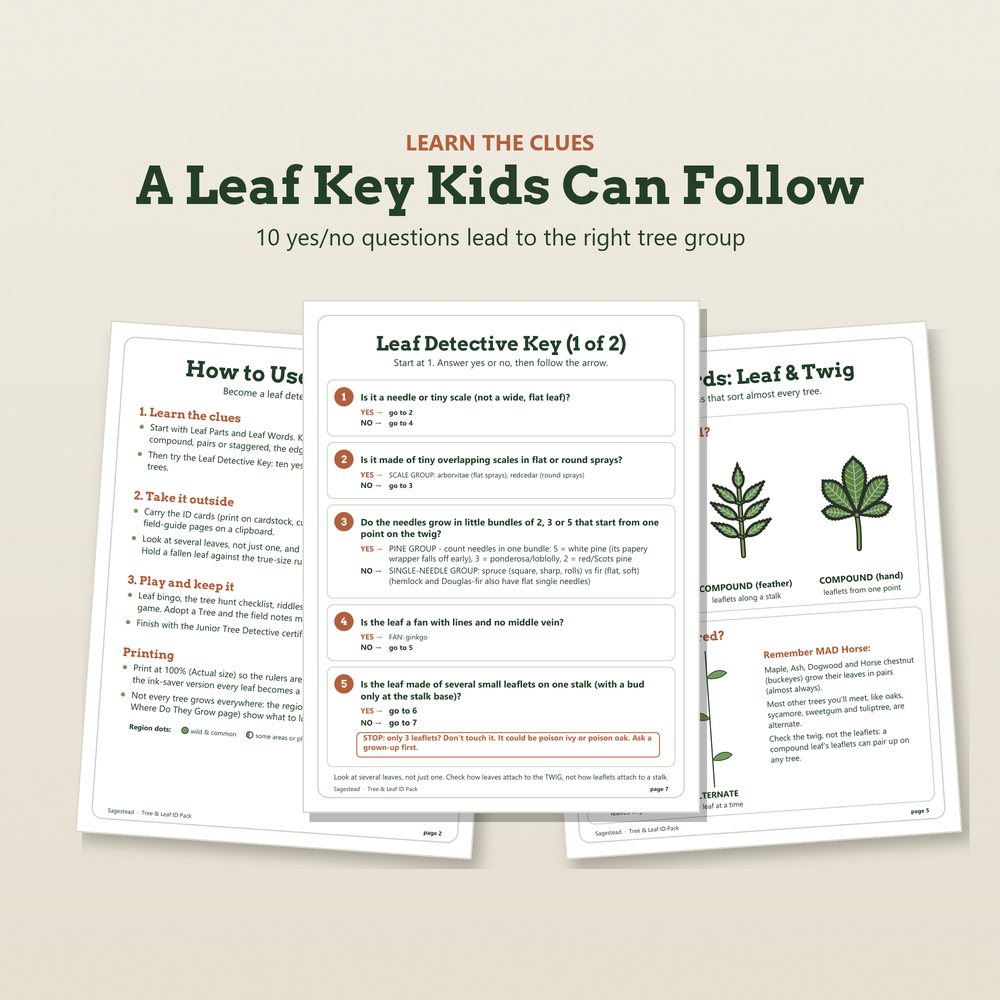
- Needle or tiny scale? Yes: it's a conifer, see below. No: go to 2.
- A fan with fine lines and no middle vein? Yes: ginkgo. No: go to 3.
- Several leaflets on one stalk, with a bud only at the base of the stalk? Yes: go to 4. No: go to 5. Only three leaflets? Don't touch it until a grown-up checks: it could be poison ivy or poison oak.
- Do the leaflets spread from one point like fingers? Yes: buckeye. No: count them. 3 to 5 coarsely toothed leaflets on green twigs, leaves in pairs, on a tree: boxelder. 7 to 9 (sometimes 5) leaflets, leaves in pairs: ash. 15 to 23, one leaf at a time: black walnut. 7 to 13 smooth leaflets on a red stem, one leaf at a time, in a wet spot? Don't touch: it could be poison sumac.
- Does the leaf have lobes? Yes: go to 6. No: go to 8.
- Are the lobes lined up along a middle vein like a feather, as on an oak? Yes: rounded lobes mean white oak; bristle-tipped points mean red oak. No, or the leaf is a mitten or has a flat top with 4 lobes: go to 7.
- Do the leaves grow in pairs on the twig? Yes: a maple. No: a special shape. A star is sweetgum, a flat top is tuliptree, a mitten is sassafras, and a giant shallow-lobed leaf is sycamore.
- Is the edge toothed like a saw? Yes: a lopsided base means elm, a round leaf on a flat stem means aspen. No: a heart is redbud; paired leaves with curving veins are dogwood; a big leathery evergreen is southern magnolia; a small leathery evergreen is live oak. A plain oval on a tree that also has mitten-shaped leaves is sassafras.
Want the whole key, with pictures? Sagestead's Tree & Leaf ID Pack has a 10-question Leaf Key kids can follow, a field guide page for each of 24 common US trees with a true-size leaf ruler, and leaf bingo for the walk. See the pack →
Maple or oak, and which one?
Maples and oaks are the leaves people most want to name, and the look-alikes trip everyone up. The difference is in the gaps, the teeth and the tips.
| Tree | Look for |
|---|---|
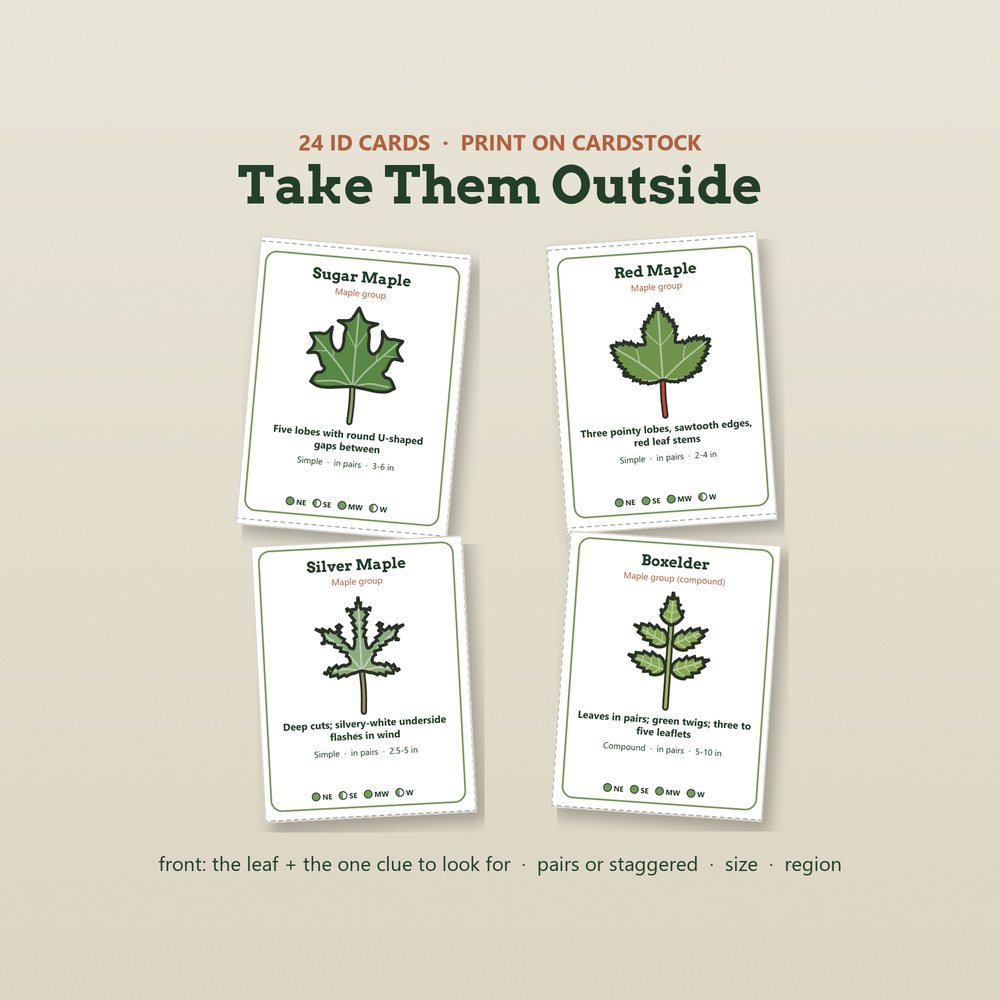
| Sugar maple | Five lobes with round, U-shaped gaps between them, and no fine teeth |
| Red maple | Three main lobes with sharp V-shaped gaps, a sawtooth edge and a leaf stem that is often red |
| Silver maple | Very deep cuts between the lobes and a silvery-white underside |
| White oak | Rounded, finger-like lobes with no bristle tips; an oval acorn with a warty cap |
| Northern red oak | Pointed lobes, each ending in a tiny bristle; a round acorn with a flat, beret-like cap |
| Southern live oak | No lobes at all: a small, leathery oval. Look for acorns to know it's an oak |
A maple or an oak? Maple lobes spread from one point like a hand, and the leaves grow in pairs. Oak lobes line up along a middle vein, and the leaves grow one at a time.
A street-tree alert. Norway maple, planted along many streets, looks like a sugar maple. Its leaf is often wider than it is long, and a snapped leaf stem oozes milky sap, while sugar maple's sap is clear.
Maple, sycamore or sweetgum? All three have hand-shaped leaves, so check the twig. Maple leaves come in pairs. Sycamore and sweetgum leaves come one at a time. Sycamore has a huge leaf and patchy, peeling bark like camouflage; sweetgum has a star-shaped leaf and spiky gumballs underneath.
Boxelder or poison ivy? Boxelder is a maple with 3 to 5 leaflets, and its leaves grow in pairs on a tree. Poison ivy has exactly three leaflets, the middle one on a longer stalk, staggered on a vine or low shrub. When in doubt, don't touch.
Needles and scales: pine, spruce or fir?
Conifers are easier than they look: count, roll and feel.
- Pines grow needles in bundles of 2, 3 or 5 that start from one point on the twig. Eastern white pine has 5 soft needles per bundle: W-H-I-T-E has five letters. Ponderosa pine usually has 3 long needles per bundle.
- Spruce needles grow one by one on tiny pegs. They're square, so they roll between your fingers, and sharp. Remember: spruce is Square, Sharp, on a Stub.
- Fir needles also grow one by one, but they're flat and soft and won't roll. Fir is Flat and Friendly. Hemlock and Douglas-fir have flat single needles too.
- Tiny overlapping scales mean arborvitae, in flat fan-shaped sprays, or eastern redcedar, in rounder sprays.
Fall color is a clue too
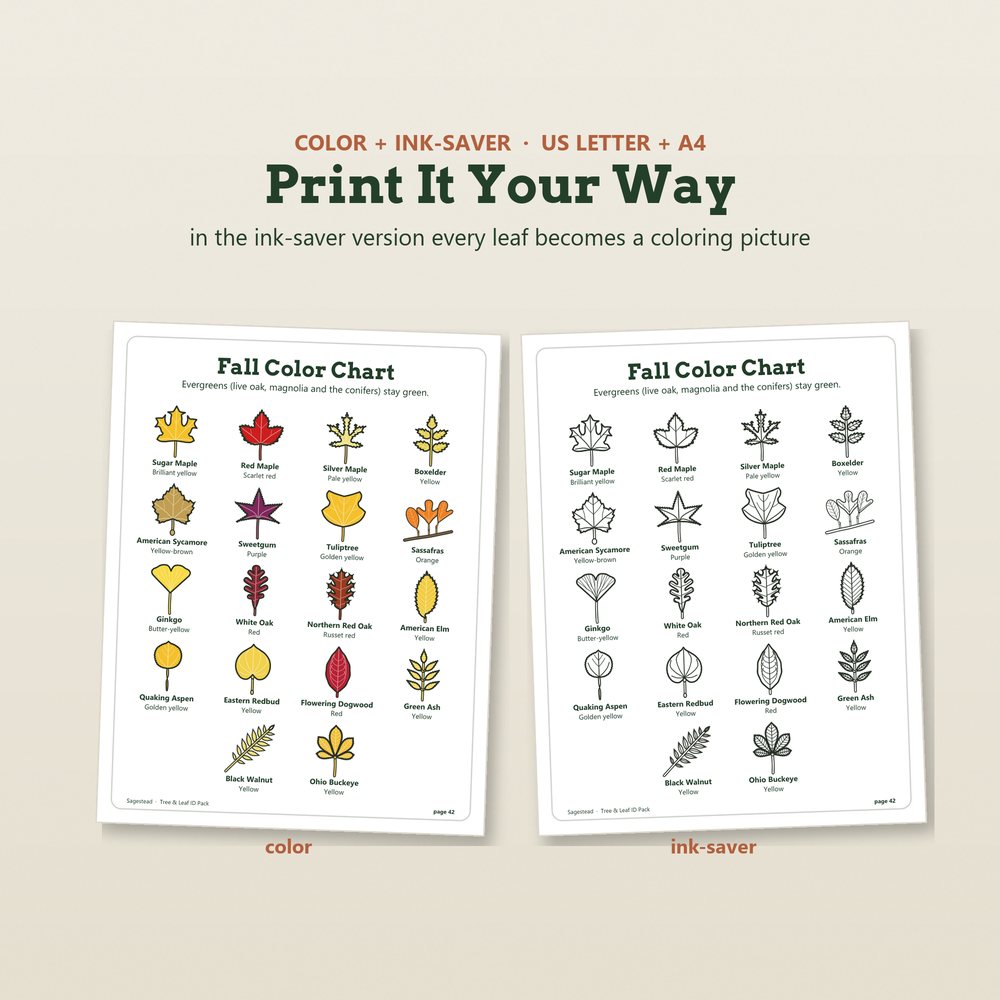
In autumn, color can point you in the right direction. Treat it as a hint and confirm with the leaf shape, because the same tree can color differently from one year and one spot to the next.
| Tree | Typical fall color |
|---|---|
| Sugar maple | Brilliant yellow, orange and red |
| Red maple | Scarlet red |
| Sweetgum | Purple, often mixed with red and yellow |
| Ginkgo | Butter-yellow |
| Sassafras | Orange |
| White oak | Red to wine-purple, then brown |
| Quaking aspen and tuliptree | Golden yellow |
| Flowering dogwood | Red |
Live oak, southern magnolia and the pines, spruces, firs and arborvitae in this guide are evergreen, so they stay green all winter.
How to make leaf ID fun for kids
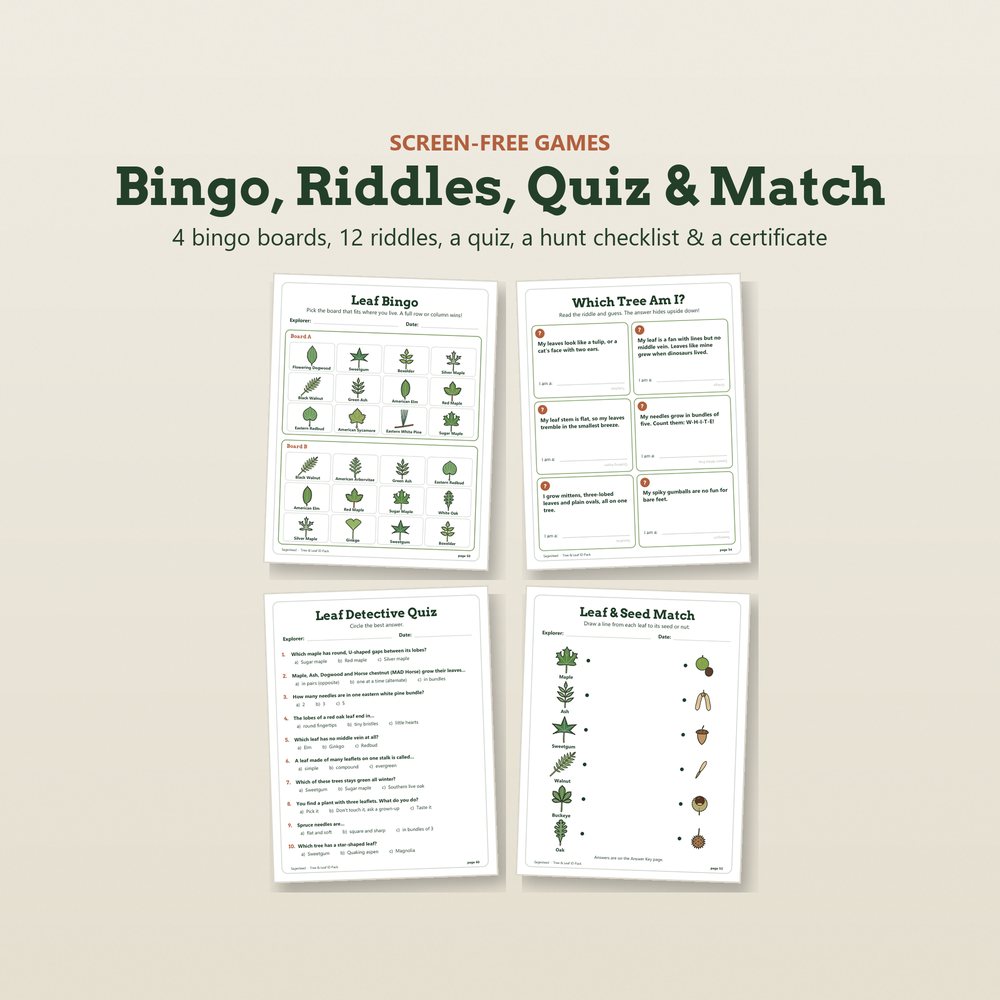
Children don't need to memorize 24 pictures. Teach them the four clues, hand them a clipboard, and let them be leaf detectives. A few ideas that work on any walk:
- Leaf rubbing, 5 minutes. Put a fresh, flat leaf vein-side up on a table, lay thin paper on top, and rub with the long side of a peeled crayon. The veins and the edge appear like magic.
- Pressing leaves, 1 to 2 weeks. Collect flat, dry fallen leaves on a dry day. Put each between two sheets of plain paper inside a heavy book, stack more books on top and wait.
- Leaf bingo. A board of leaves to spot on the walk; a full row wins.
- Adopt a tree. Visit the same tree every season, draw it and write what changed.
- Measure a trunk. Wrap a string around the trunk at about 4.5 feet up, the height foresters call breast height, then lay the string along a tape measure.
Pick up fallen leaves rather than pulling them off the tree, and ask before collecting in a park: some parks and nature preserves don't allow it. After walks in woods or tall grass, check for ticks.
If anyone swallows a plant part, call Poison Help at 1-800-222-1222, free and open 24/7. Call 911 if someone has trouble breathing or won't wake up.
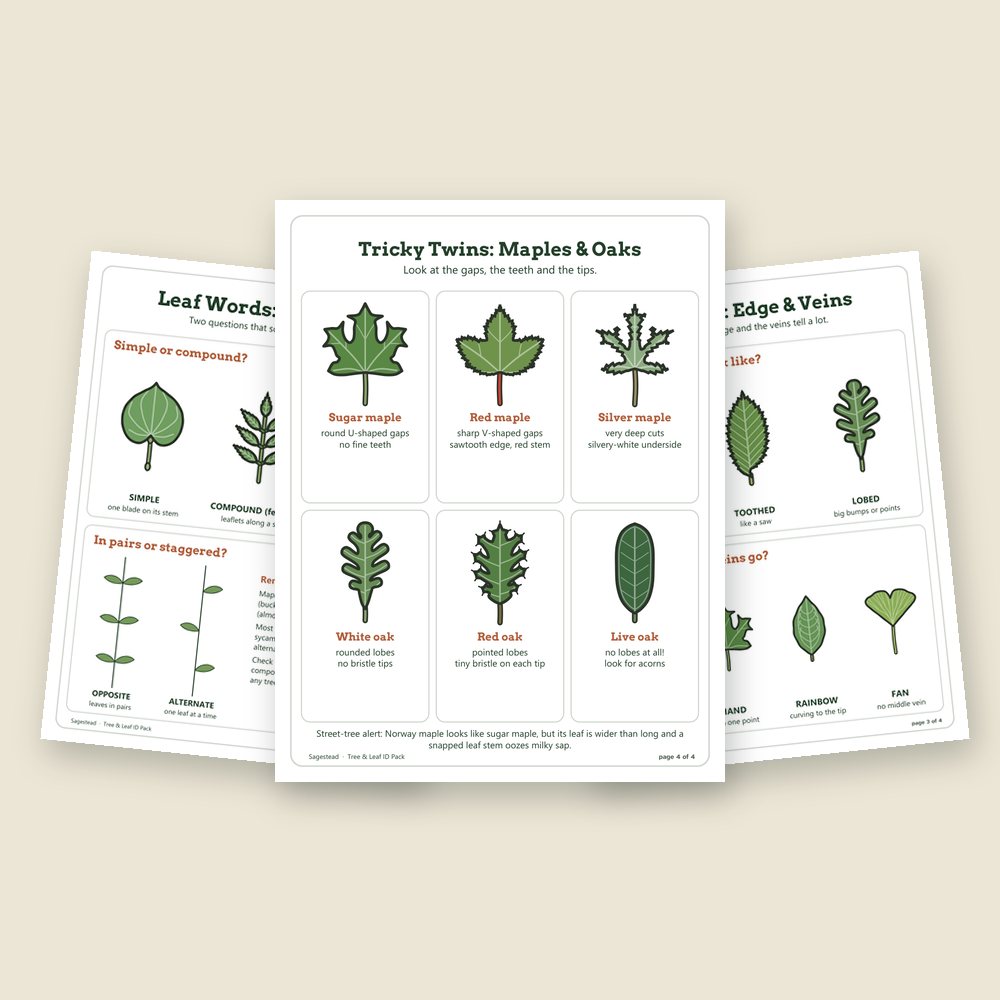
Free leaf identification cheat sheet
Three real pages from the Sagestead Tree & Leaf ID Pack, ready to clip to a board and take outside.
- Simple or compound, pairs or staggered, with pictures
- Edges and veins at a glance
- Tricky twins: sugar, red and silver maple, white, red and live oak
- A one-page how-to with safety notes