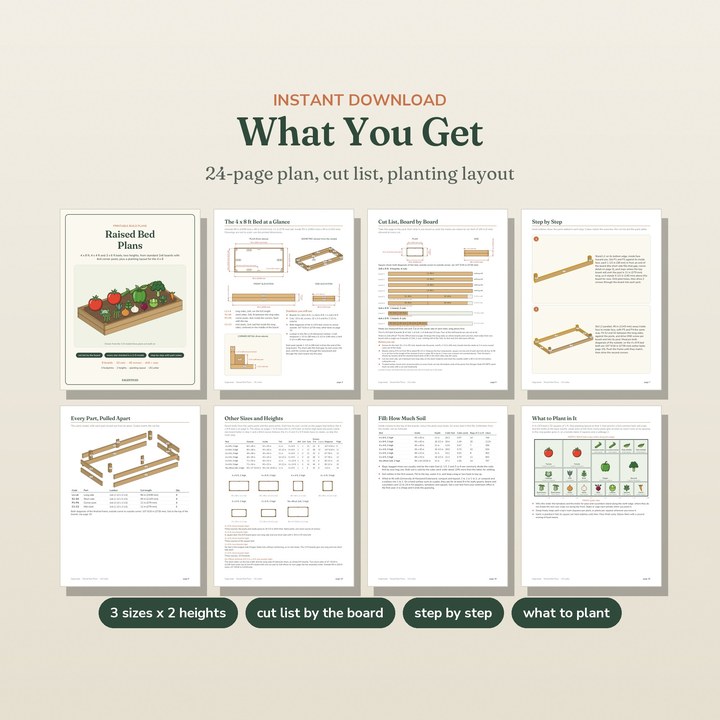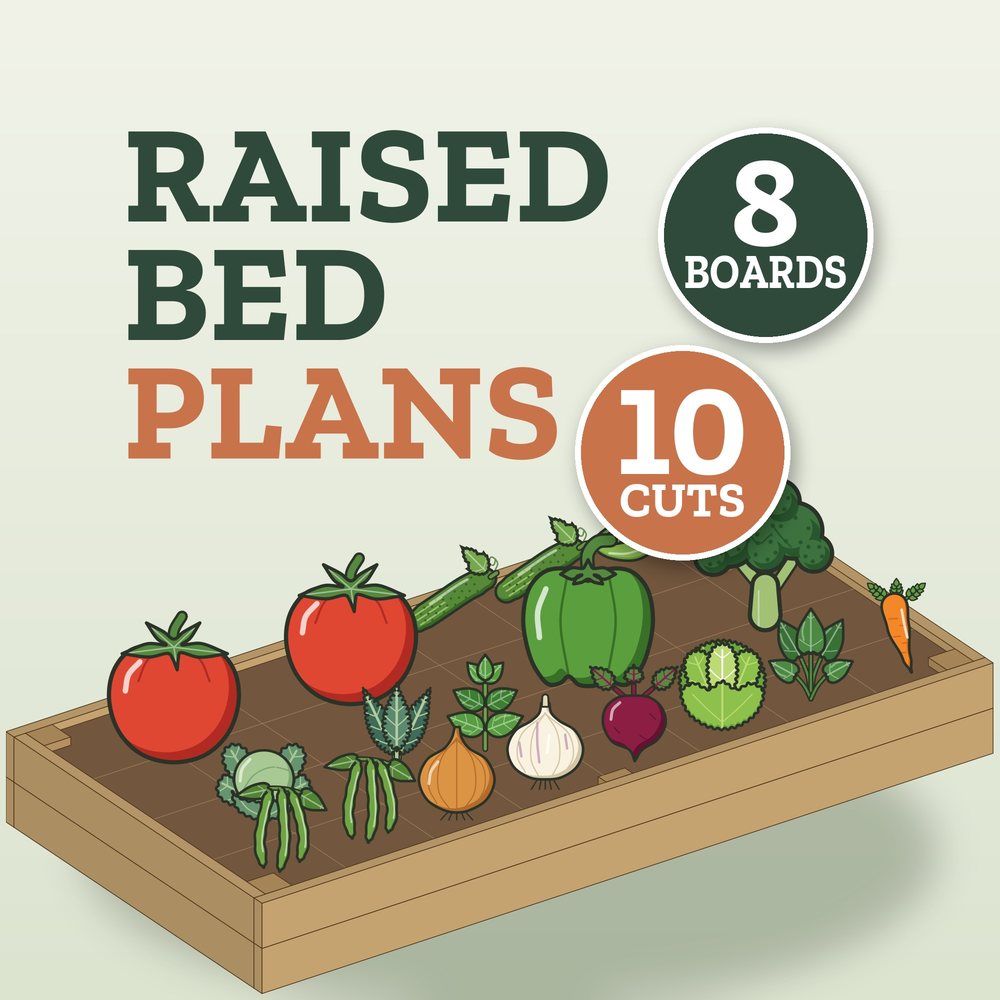
The short answer: a 4 x 8 ft raised bed two boards high takes eight boards and ten cuts: six 2x6 x 8 ft boards for the sides, one 4x4 for the corner posts and one 2x4 for two mid cleats. Four long boards stay whole; the four short sides are cut to 45 inches, the posts and cleats to 11 inches. Screw the boards to posts set inside the corners, square the frame until both diagonals measure 107 5/16 inches, set it on level ground and fill it with about 26 cubic feet of soil.
Size first: 4 feet wide, 11 or 16 1/2 inches tall
Width. Oregon State University Extension puts the maximum width of a raised bed at 4 feet. That's the width you can reach into from both sides without ever stepping on the soil, and soil that's never walked on stays loose, which is the whole point of a raised bed.
Length. Eight feet is the classic, because lumber is sold in 8 ft lengths. Oregon State asks for reinforcing on beds longer than 6 feet or taller than about 18 inches, so the weight of wet soil doesn't push the long sides outward. On the 4 x 8 bed here, a mid cleat ties each long side into one wall, and two stakes from the 2x4 offcut can anchor it as well.
Height. A 2x6 board is really 5 1/2 inches wide, so two boards stacked make a bed 11 inches tall and three make 16 1/2 inches. University of Georgia Extension calls 6 to 8 inches typical for raised beds, and taller beds kinder to gardeners who'd rather not bend.
| Bed | Outside | Inside | Tall |
|---|---|---|---|
| 4 x 8 ft, two boards high | 96 x 48 in | 93 x 45 in | 11 in |
| 4 x 8 ft, three boards high | 96 x 48 in | 93 x 45 in | 16 1/2 in |
| 4 x 4 ft, two boards high | 48 x 48 in | 45 x 45 in | 11 in |
| 3 x 6 ft, two boards high | 72 x 36 in | 69 x 33 in | 11 in |
Which wood to use for a vegetable bed
University extension services point to two choices for beds you'll eat from:
- Naturally decay-resistant wood: cedar or redwood (Oregon State), or black cherry and oak (University of Maryland).
- Lumber pressure-treated with a preservative approved for residential use and labeled for ground contact. In Oregon State's field study of copper-azole treated Douglas-fir beds, copper rose in the soil only within about an inch of the boards and did not rise in the vegetables and herbs grown in them.
- Never: railroad ties, creosote-treated wood or old CCA lumber, an arsenic-based treatment withdrawn from residential use in 2004.
Prefer an extra layer? University of Maryland Extension suggests lining the inside walls with heavy plastic, leaving the bottom open so the bed drains. With treated lumber, brush an end-cut preservative on every fresh cut, as Oregon State advises, wear gloves and a dust mask while cutting it outdoors, and never burn the offcuts.
What to buy for a 4 x 8 ft bed
| Item | How many | What it's for |
|---|---|---|
| 2x6 x 8 ft board (1 1/2 x 5 1/2 in) | 6 | The sides: four long, four short |
| 4x4 x 8 ft post (3 1/2 x 3 1/2 in) | 1 | Four corner posts |
| 2x4 x 8 ft board (1 1/2 x 3 1/2 in) | 1 | Two mid cleats |
| 3 in exterior wood screws | 32 | Boards into the posts |
| 2 1/2 in exterior wood screws | 8 | Boards into the cleats (a 3 in screw would come out the far side) |
| End-cut wood preservative | 1 | Fresh cut ends of treated lumber |
Buy surfaced boards (S4S) that measure 1 1/2 x 5 1/2 inches; rough-sawn cedar is often thicker and wider, and changes every length. Sight down each board and put back any that twist or bow. Screws must be rated for exterior use and for the treatment on your lumber. Tools: a drill or impact driver, a circular saw or hand saw, a tape measure, a carpenter's square, two clamps or a helper, a level, and eye and hearing protection.
The cut list: eight boards, ten cuts
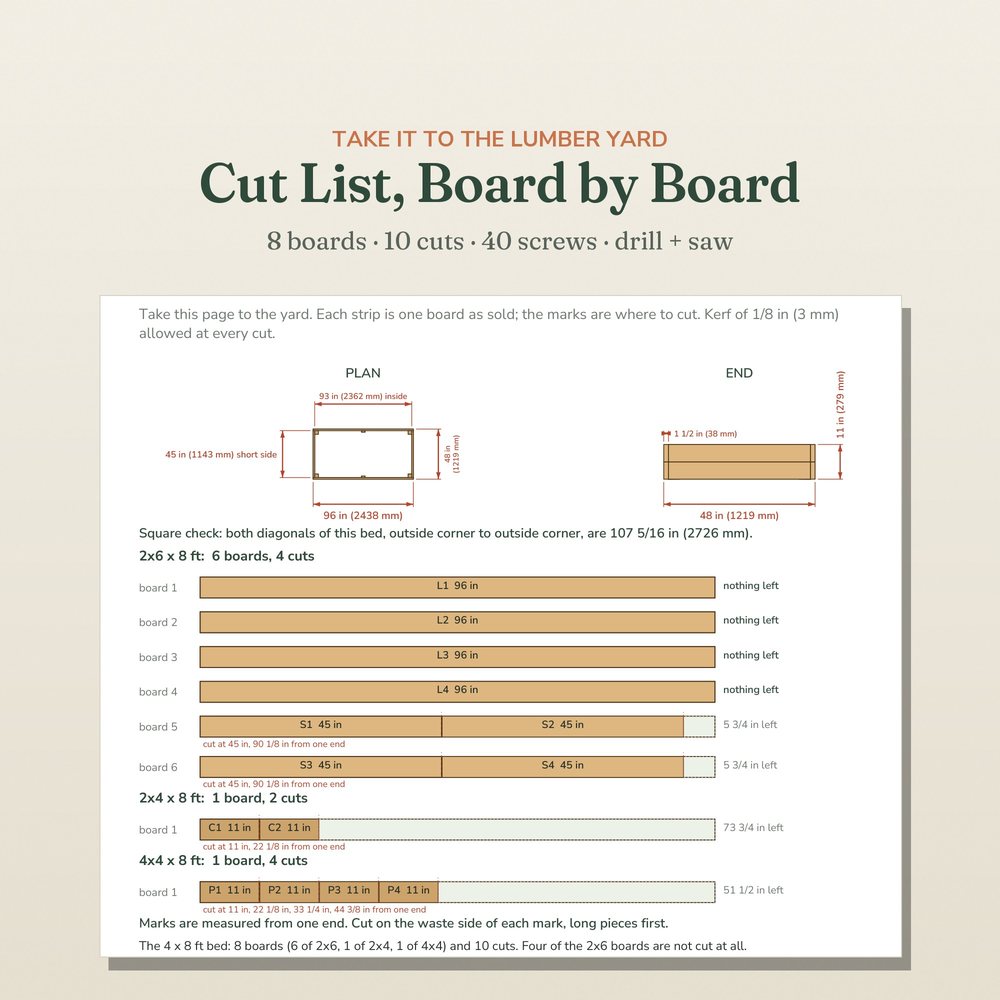
- 2x6 boards 1 to 4: the long sides, L1 to L4, 96 inches. No cuts at all.
- 2x6 boards 5 and 6: two short sides each, 45 inches, marked at 45 and 90 1/8 inches from one end. 5 3/4 inches left over.
- The 2x4: two mid cleats, 11 inches each, marked at 11 and 22 1/8 inches.
- The 4x4: four corner posts, 11 inches each, marked at 11, 22 1/8, 33 1/4 and 44 3/8 inches.
Those odd eighths are the saw blade: each mark allows 1/8 inch for the cut. Measure every mark from the same end and cut on the waste side of the line. Boards sold as 8 ft often run a little long, up to about 96 1/2 inches, so square one end of each long board and trim all four to the same length.
Check before you cut them all: cut one short side, set it between two long sides on the ground and make sure the outside width is 48 inches. Then cut the rest.
How to build a raised bed, step by step
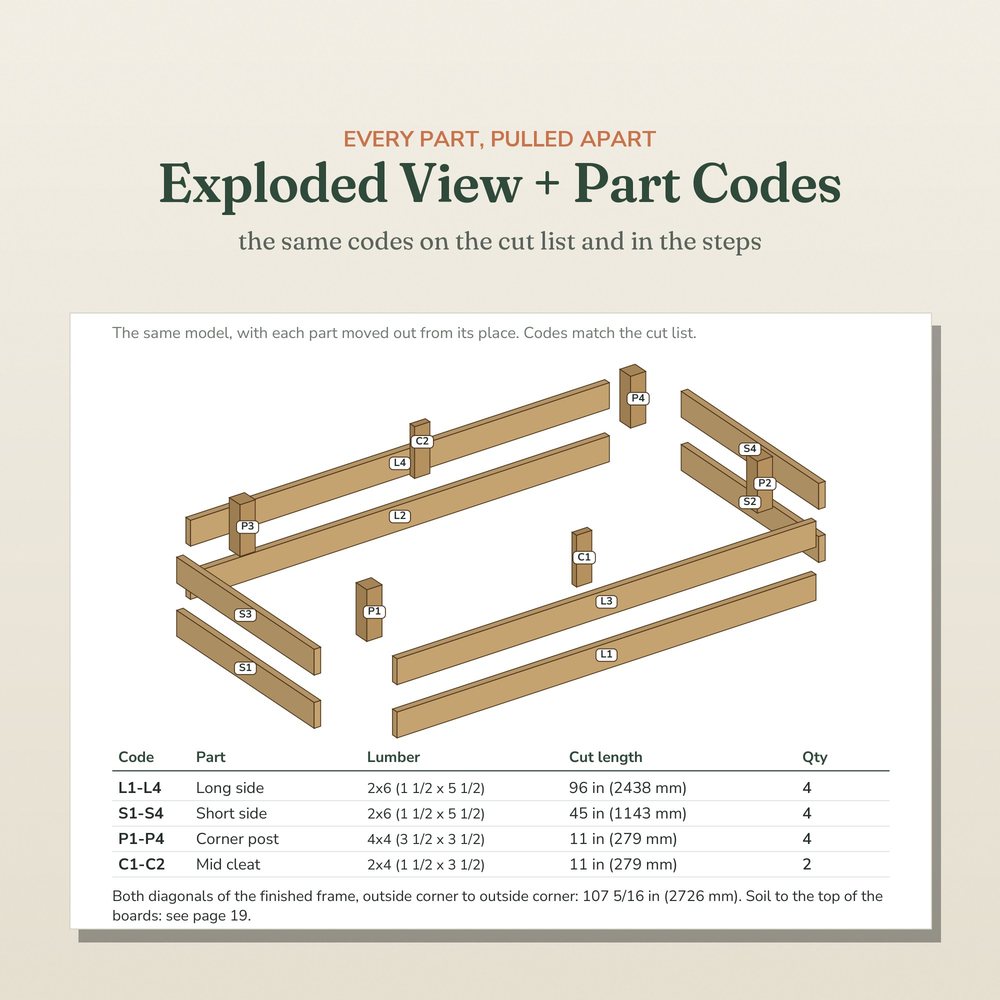
The corner posts stand inside the frame, set back 1 1/2 inches from the ends of the long boards; the short sides fill that gap and cover the posts. That one detail is why the bed needs no brackets.
- First long side. Stand a long board on its edge, inside face toward you. Set two posts against it, each 1 1/2 inches in from an end, tops where the top board will end. Drill pilot holes and drive 2 screws through the board into each post.
- Second long side. Do the same with the other long board and two posts, and stand it parallel, 45 inches away inside face to inside face.
- Close the box. Fit two short sides between the long sides, against the posts, with one screw per board end.
- Square it. Measure both diagonals of the outside, corner to corner. On a 4 x 8 ft bed both are 107 5/16 inches. Push the frame until they match, then drive the second screws.
- The second course. Set the other four boards on top of the first ones, against the posts, two screws per board end. The tops now sit flush with the posts. Check the diagonals again.
- The cleats. Lay a 2x4 cleat flat inside the middle of each long side, its near edge 46 1/4 inches from the end, and drive 2 screws of 2 1/2 inches through each board into it. Each long side is now one wall.
Set it in place
- Call before you dig. In the US, call 811 before leveling a site, and keep the frame clear of buried lines, sprinkler heads and tree roots.
- Level the ground. Scrape high spots away rather than filling low ones, so the frame sits on firm soil and the corners stay closed.
- Optional, against burrowing animals: turn the frame over and staple 1/2-inch hardware cloth across the bottom, cut to the outside size, 96 x 48 inches.
- Carry it with two people, then check level both ways and the diagonals once more: carrying racks a frame.
- Leave the bottom open. A raised bed drains into the ground below it.
Building a different size? Sagestead's Raised Bed Plans have a cut list for 4 x 8, 4 x 4 and 3 x 6 ft beds, two or three boards high, with step-by-step drawings, part codes and an exploded view. See the plans →
How much soil a raised bed takes
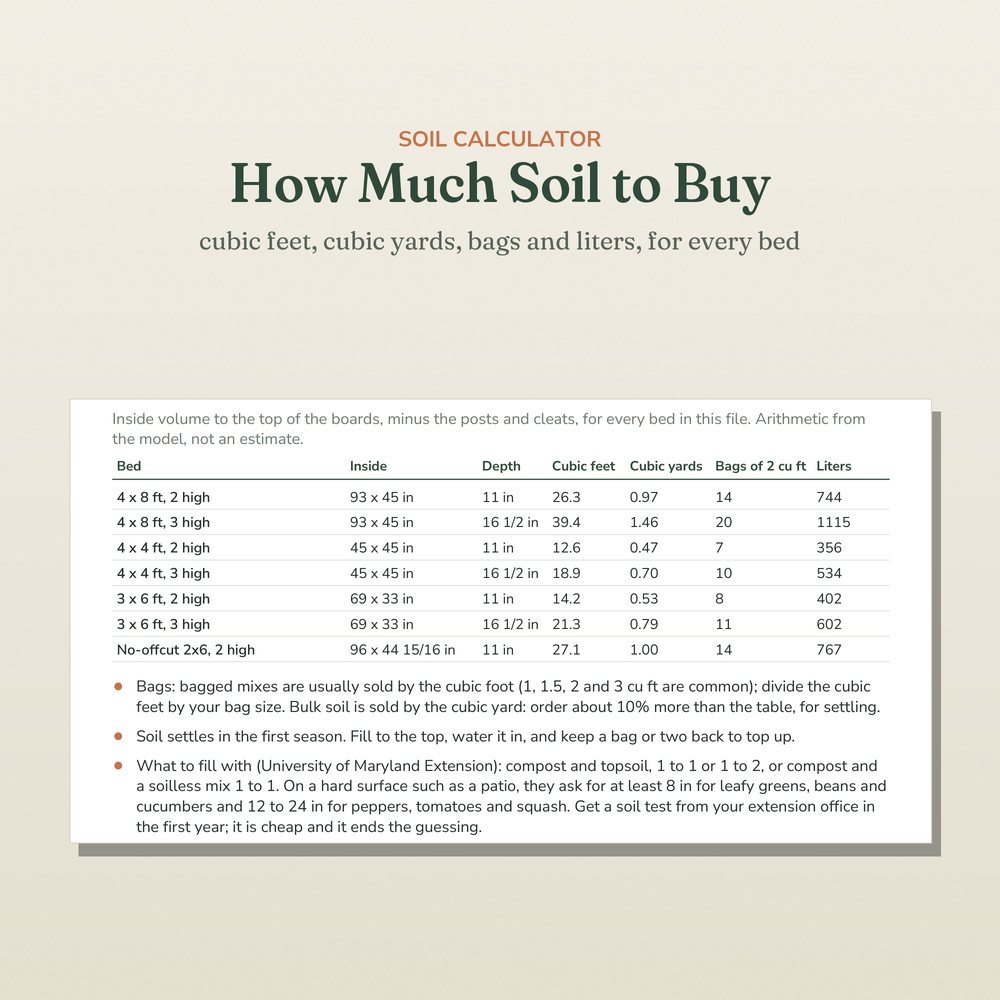
The numbers below are the inside volume to the top of the boards, minus the posts and cleats, so they're what you'll actually pour in. Bagged mixes are sold by the cubic foot, so divide by your bag size; bulk soil comes by the cubic yard, so order about 10% more for settling. For the fill itself, University of Maryland Extension suggests compost and topsoil, 1 to 1 or 1 to 2, or compost and a soilless mix 1 to 1. Fill to the top, water it in, let it settle a day, and keep a bag or two back to top up during the first season.
| Bed | Cubic feet | Cubic yards | Bags of 2 cu ft |
|---|---|---|---|
| 4 x 8 ft, 11 in deep | 26.3 | 0.97 | 14 |
| 4 x 8 ft, 16 1/2 in deep | 39.4 | 1.46 | 20 |
| 4 x 4 ft, 11 in deep | 12.6 | 0.47 | 7 |
| 3 x 6 ft, 11 in deep | 14.2 | 0.53 | 8 |
What to plant in a 4 x 8 bed
A 4 x 8 ft bed is 32 squares of 1 foot. Put tall crops and a trellis along the north side, where they won't shade the rest, and low crops along the front. Give each plant at least the room its spacing asks for: a tomato takes 4 squares, a cabbage 2, a kale plant 1, and a single square holds 4 lettuces, 9 onions or 16 carrots. Walk around the bed, never in it, and water when the soil is dry 2 inches down: a raised bed dries faster than the ground.
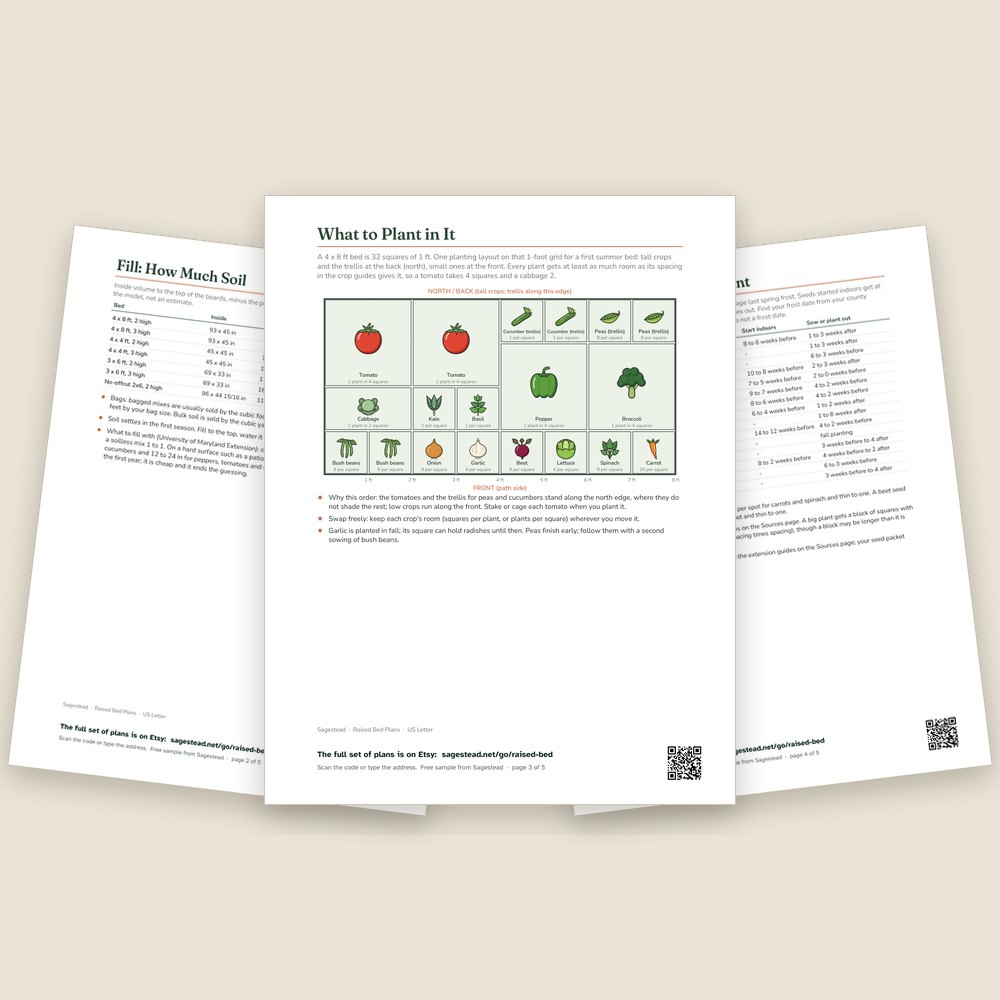
Free raised bed soil and planting sheets
Three pages from Sagestead Raised Bed Plans to take to the garden center and out to the bed.
- Soil for seven bed sizes: cubic feet, cubic yards, bags and liters
- A planting layout for a 4 x 8 ft bed on a 1-foot grid
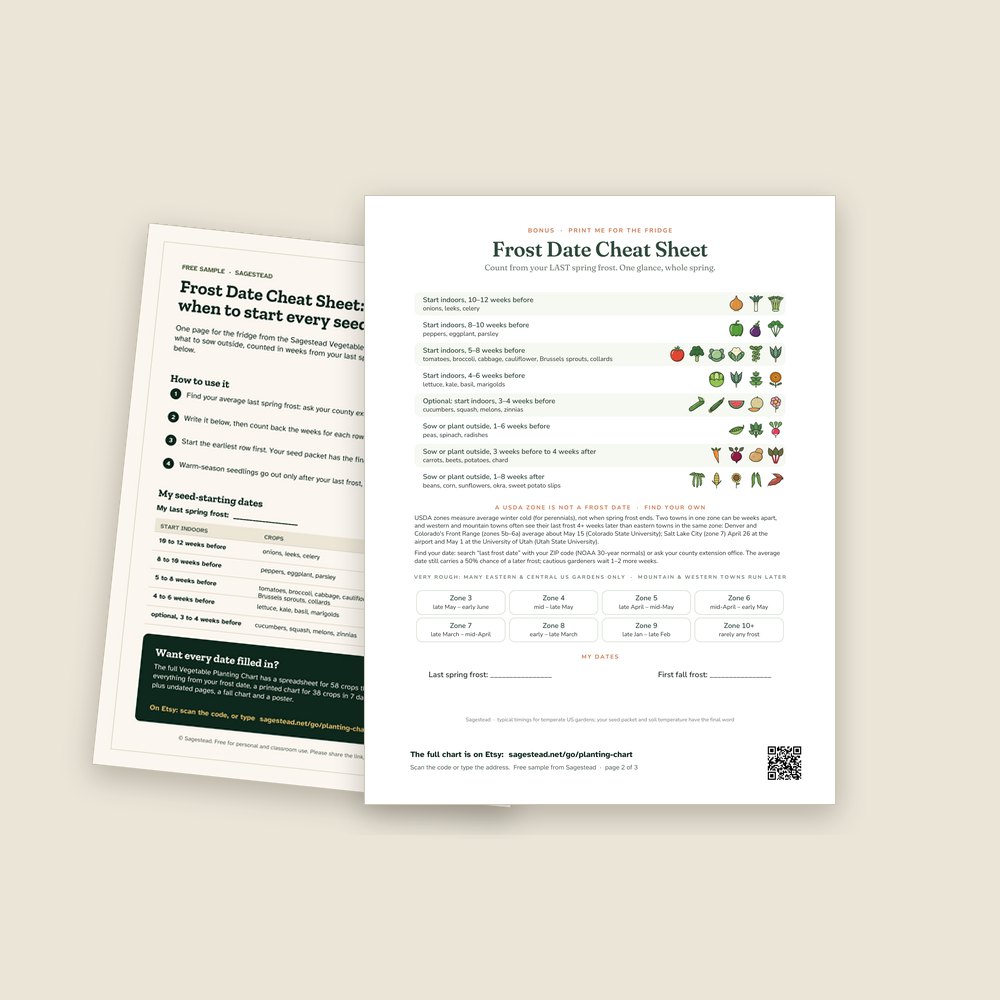
- When to start and plant each crop, from your last frost
- What to fill the bed with