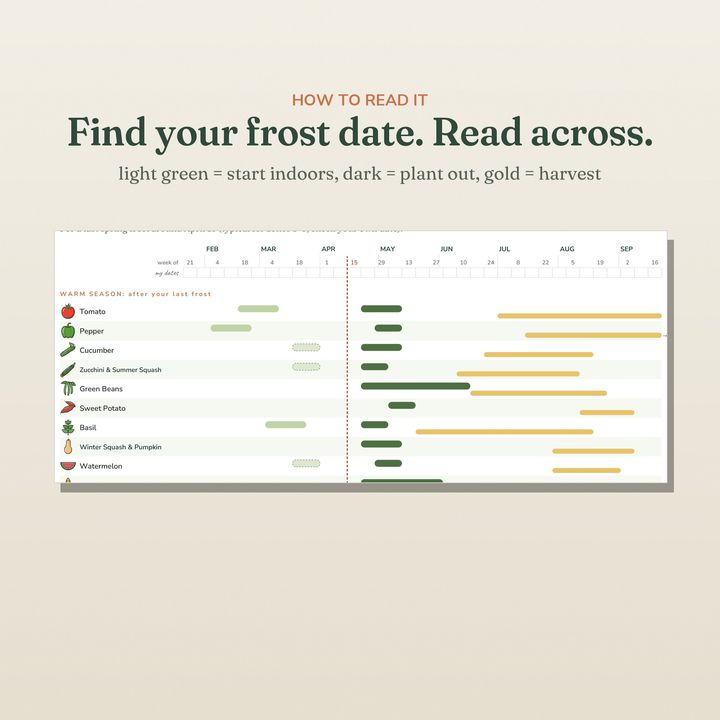
The short answer: count back from your average last spring frost date. Start onions, leeks and celery 10 to 12 weeks before it; peppers, eggplant and parsley 8 to 10 weeks before; tomatoes and the cabbage family 5 to 8 weeks before; lettuce, kale and basil 4 to 6 weeks before; and cucumbers, squash and melons, if you start them indoors at all, 3 to 4 weeks before. Peas, carrots, beets, beans and corn are sown straight into the garden. Give seedlings 14 to 16 hours of light a day and about two weeks of hardening off before they go out.
Step 1: find your last frost date (not your zone)
Every seed-starting date hangs on one number: the average date of the last spring frost where you live. Your county extension office can tell you, and many frost date lookups by ZIP code are built on NOAA's 30-year climate normals.
- A USDA zone is not a frost date. Zones measure average winter cold, which matters for perennials, not when spring frosts end. Two towns in one zone can be weeks apart: Denver and Colorado's Front Range (zones 5b to 6a) average a last frost around May 15 (Colorado State University), while many eastern towns in the same zones see theirs weeks earlier.
- The average is the middle, not the end. NC State Extension explains that the 50% date is the median: there is still an even chance of a frost on or after it. Cautious gardeners wait a week or two longer before setting out tomatoes and peppers.
- Write it down once. On the calendar, on the fridge, on the seed box. Everything below counts from it.
Step 2: count back the weeks
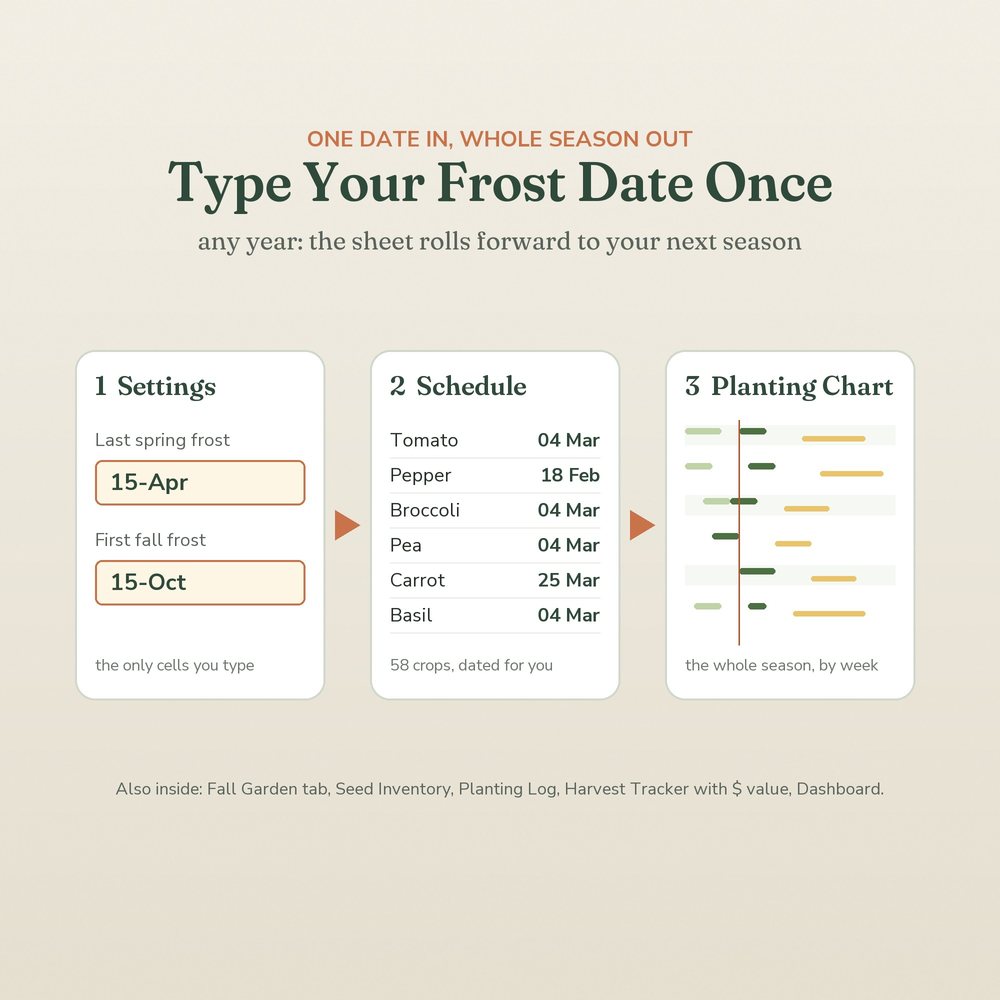
Here are the windows from the Sagestead Frost Date Cheat Sheet, with the dates they give for a last frost around April 15. Swap in your own date: if yours is May 15, every date moves a month later.
| Start indoors | Crops | Last frost April 15 |
|---|---|---|
| 10 to 12 weeks before | Onions, leeks, celery | January 21 to February 4 |
| 8 to 10 weeks before | Peppers, eggplant, parsley | February 4 to February 18 |
| 5 to 8 weeks before | Tomatoes, broccoli, cabbage, cauliflower, Brussels sprouts, collards | February 18 to March 11 |
| 4 to 6 weeks before | Lettuce, kale, basil, marigolds | March 4 to March 18 |
| Optional: 3 to 4 weeks before | Cucumbers, squash, melons, zinnias | March 18 to March 25 |
The ranges are windows, not deadlines. Start at the early end if you'll pot the seedlings up into bigger containers; start at the late end if they'll stay in small cells. Your seed packet has the final word for each variety.
Starting much earlier than the window rarely helps. The seedlings simply wait indoors, getting taller and more crowded, for a planting day that is set by the weather.
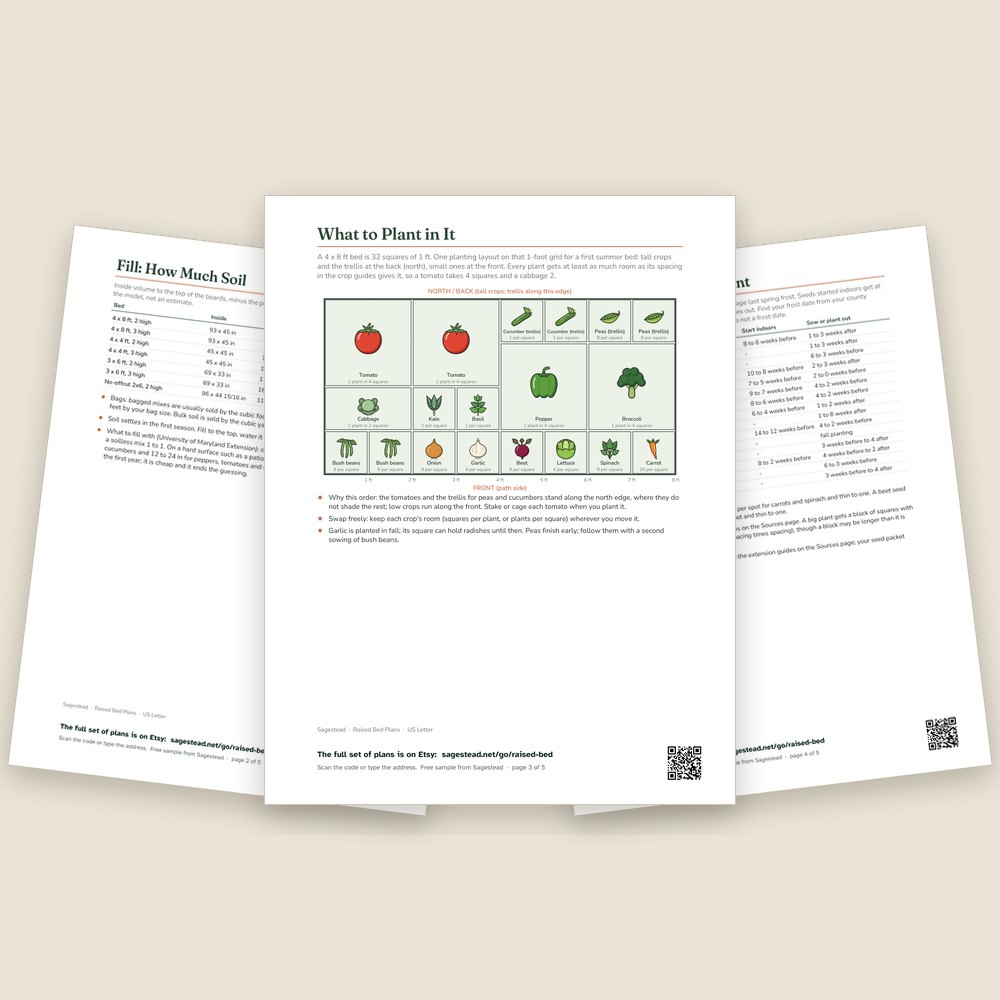
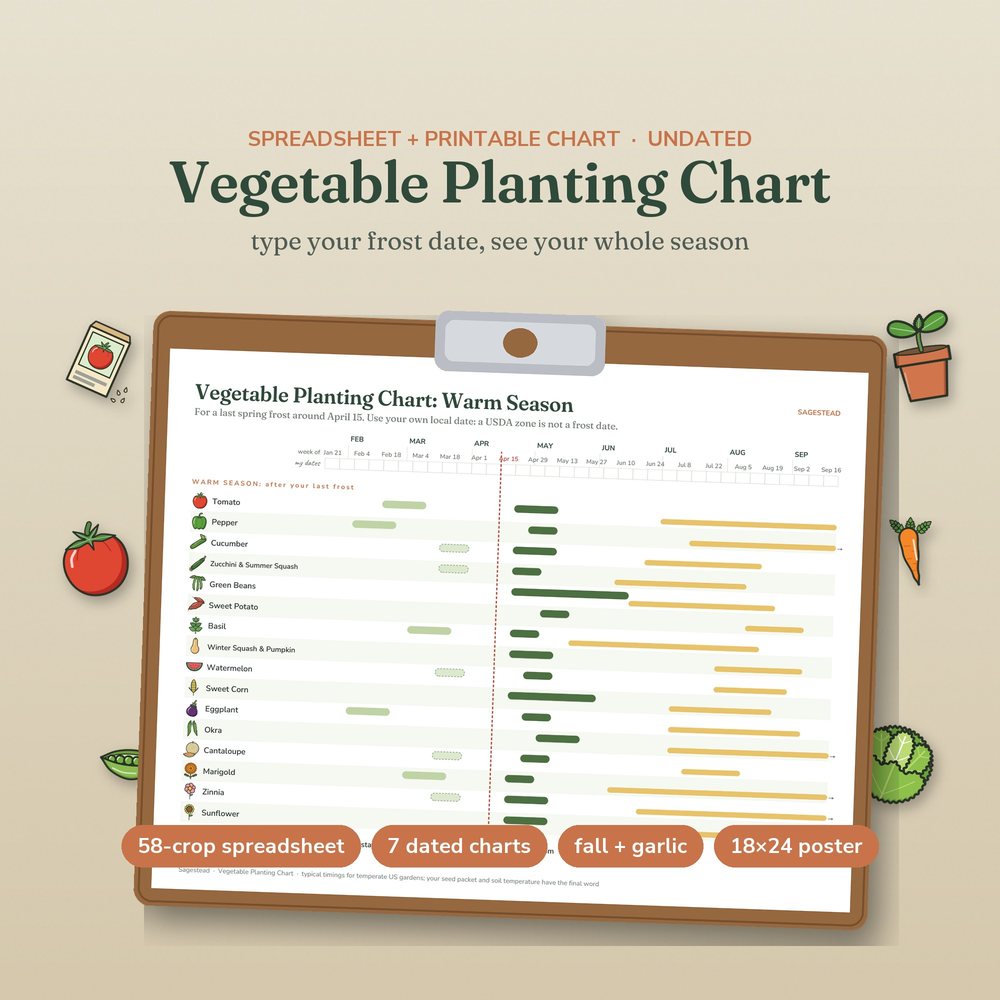
Rather not count weeks at all? Sagestead's Vegetable Planting Chart comes in 7 dated editions, for a last frost of March 1, March 15, April 1, April 15, May 1, May 15 or June 1, plus a spreadsheet that dates 58 crops from the frost date you type in. See the chart →
Why tomatoes and onions start weeks apart
Two things set each crop's window: how long its seedling takes to grow to transplant size, and when it can safely go outside.
Seedling age. NC State Extension's Gardener Handbook gives the weeks each transplant takes to grow from seed: onions 10 to 12, eggplant and peppers 6 to 8, tomatoes, broccoli and cabbage 5 to 7, lettuce 4 to 5, summer squash 3 to 4 and cucumbers 2 to 3. Clemson Extension gives a little longer for some crops, 8 to 10 weeks for peppers and 6 to 8 for tomatoes, which is why charts differ by a week or two.
Planting day. Cool-season crops like onions, cabbage, broccoli and lettuce go out before the last frost, so their window ends early. Warm-season crops like tomatoes, peppers, basil and cucumbers wait until after it. A pepper starts early because it grows slowly, then waits for warm weather; a cucumber grows so fast that a few weeks indoors is plenty.
| Crop | Weeks to grow from seed (NC State) | Goes outside |
|---|---|---|
| Onion | 10 to 12 | Before the last frost |
| Pepper, eggplant | 6 to 8 | After the last frost |
| Tomato | 5 to 7 | After the last frost |
| Broccoli, cabbage | 5 to 7 | In the weeks before the last frost |
| Lettuce | 4 to 5 | Around the last frost |
| Summer squash | 3 to 4 | After the last frost |
| Cucumber | 2 to 3 | After the last frost |
Seeds to sow straight in the garden
Not every seed belongs indoors. These go straight into the ground, counted from the same frost date:
- 1 to 6 weeks before the last frost: peas, spinach, radishes.
- 3 weeks before to 4 weeks after: carrots, beets, chard, and seed potatoes.
- 1 to 8 weeks after: beans, corn, sunflowers, okra and sweet potato slips.
Cucumbers, squash and melons can go either way: a few weeks indoors for an earlier start, or sown outside once the frost has passed.
Seed-starting mix, warmth and light

- Use a fresh, soilless seed-starting mix, not garden soil or bagged topsoil. Clemson Extension points to a sterile, well-drained mix as the way to prevent damping-off, the fungus-like disease that topples seedlings at the soil line.
- Keep the mix warm while seeds sprout. 65 to 75°F suits most vegetable seeds, and a heat mat keeps it at 70 to 75°F in a cool house (University of Maryland Extension). Cover the tray with a clear lid or plastic until they're up.
- Light them 14 to 16 hours a day, with the lights 2 to 6 inches above the plants and raised as they grow, on a plug-in timer (University of Maryland Extension).
- Grow them a little cooler once they're up: about 65 to 70°F by day and 55 to 60°F at night (University of Maryland Extension).
- Water from below. Set the tray in 1 to 2 inches of water for a few minutes and let the mix soak it up, then let the extra drain (Clemson Extension).
- Feed lightly once true leaves appear, with a water-soluble starter fertilizer at every other watering and plain water in between (Clemson Extension).
Reusing last year's trays? Wash them, then soak them for a minute or two in 1 part chlorine bleach to 10 parts water and rinse (University of Maryland Extension).
Hardening off and planting out
Seedlings raised indoors have never felt wind or full sun. Hardening off gets them used to both. Illinois Extension suggests starting about two weeks before planting day:
- First days: 2 to 3 hours outside in the warmest part of the day.
- Each day after: a little longer outside and a little more sun. Water less often, but never let them wilt, and hold off on fertilizer.
- Once they handle 10 to 12 hours outside: leave them out day and night for a couple of days.
- Planting day: cool-season crops go in on their dates before the frost; tomatoes, peppers and the rest of the warm-season crops only after your last frost.
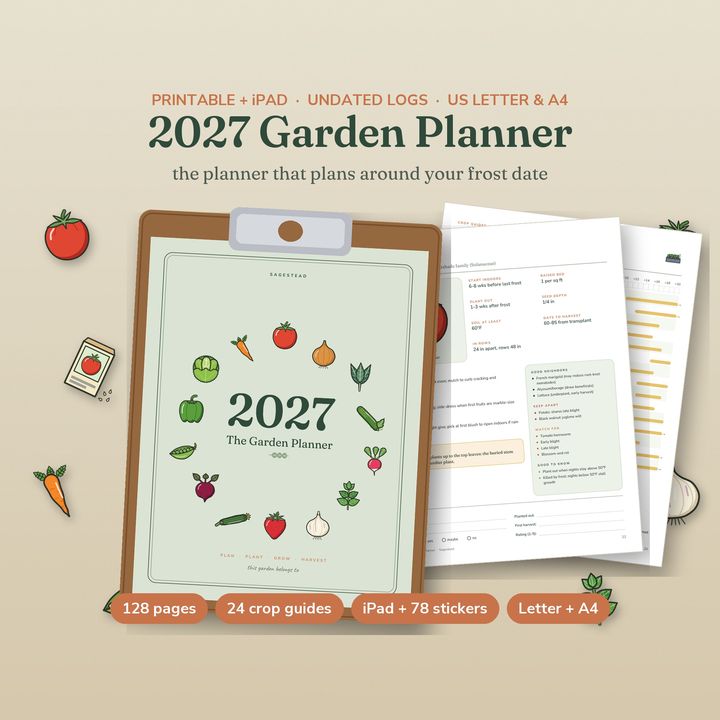
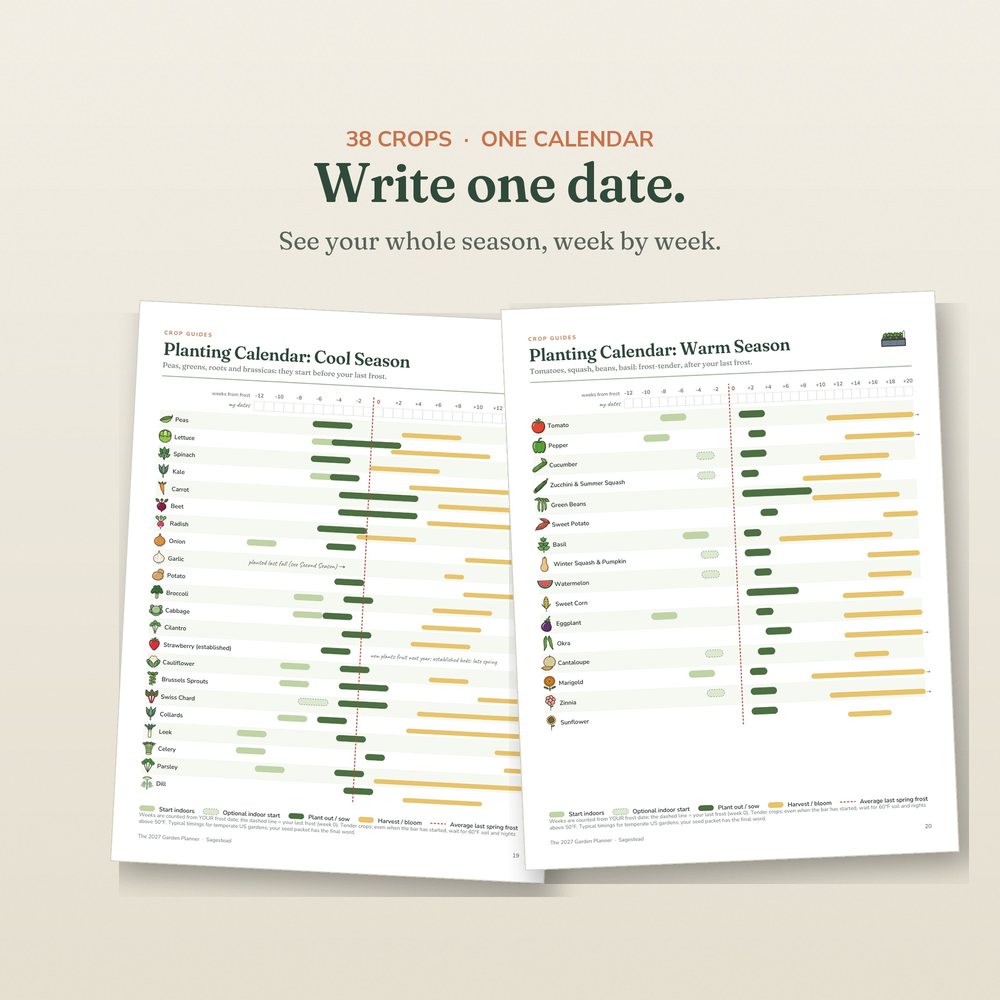
Keeping a garden journal this year? The Sagestead 2027 Garden Planner has 128 pages: planting calendars for 38 crops counted from your frost date, 24 crop guides and logs for the whole season. See the planner →
Free Frost Date Cheat Sheet
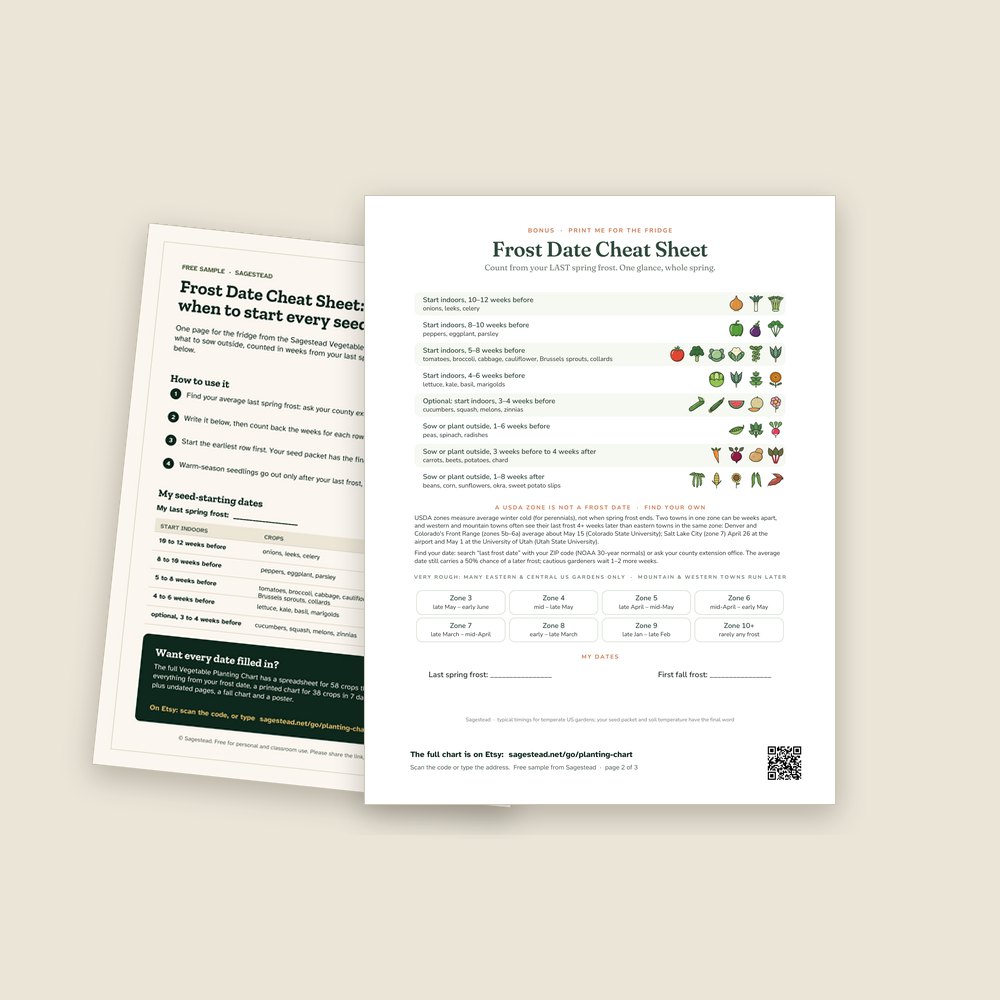
One page for the fridge from the Sagestead Vegetable Planting Chart, with a page in front to write your own seed-starting dates.
- What to start indoors, 3 to 12 weeks before your last frost
- What to sow or plant outside, and when
- Why a USDA zone is not a frost date, and how to find yours
- A table for your own dates, row by row